@richey
2019-04-28T00:26:44.000000Z
字数 9518
阅读 1459
react最佳实践
react eva umi javascript
知识地图
不知大家学 react 或 dva 时会不会有这样的疑惑:
- es6 特性那么多,我需要全部学会吗?
- react component 有 3 种写法,我需要全部学会吗?
- reducer 的增删改应该怎么写?
- 怎么做全局/局部的错误处理?
- 怎么发异步请求?
- 怎么处理复杂的异步业务逻辑?
- 怎么配置路由?
- ...
这篇文档梳理了基于 dva-cli 使用 dva 的最小知识集,让你可以用最少的时间掌握创建类似 dva-hackernews 应用的全部知识,并且不需要掌握额外的冗余知识。
JavaScript 语言
变量声明
const 和 let
不要用 var,而是用 const 和 let,分别表示常量和变量。不同于 var 的函数作用域,const 和 let 都是块级作用域。
const DELAY = 1000;let count = 0;count = count + 1;
模板字符串
模板字符串提供了另一种做字符串组合的方法。
const user = 'world';console.log(`hello ${user}`); // hello world// 多行const content = `Hello ${firstName},Thanks for ordering ${qty} tickets to ${event}.`;
默认参数
function logActivity(activity = 'skiing') {console.log(activity);}logActivity(); // skiing
箭头函数
函数的快捷写法,不需要通过 function 关键字创建函数,并且还可以省略 return 关键字。
同时,箭头函数还会继承当前上下文的 this 关键字。
比如:
[1, 2, 3].map(x => x + 1); // [2, 3, 4]
等同于:
[1, 2, 3].map((function(x) {return x + 1;}).bind(this));
模块的 Import 和 Export
import 用于引入模块,export 用于导出模块。
比如:
// 引入全部import dva from 'dva';// 引入部分import { connect } from 'dva';import { Link, Route } from 'dva/router';// 引入全部并作为 github 对象import * as github from './services/github';// 导出默认export default App;// 部分导出,需 import { App } from './file'; 引入export class App extend Component {};
ES6 对象和数组
析构赋值
析构赋值让我们从 Object 或 Array 里取部分数据存为变量。
// 对象const user = { name: 'guanguan', age: 2 };const { name, age } = user;console.log(`${name} : ${age}`); // guanguan : 2// 数组const arr = [1, 2];const [foo, bar] = arr;console.log(foo); // 1
我们也可以析构传入的函数参数。
const add = (state, { payload }) => {return state.concat(payload);};
析构时还可以配 alias,让代码更具有语义。
const add = (state, { payload: todo }) => {return state.concat(todo);};
对象字面量改进
这是析构的反向操作,用于重新组织一个 Object 。
const name = 'duoduo';const age = 8;const user = { name, age }; // { name: 'duoduo', age: 8 }
定义对象方法时,还可以省去 function 关键字。
app.model({reducers: {add() {} // 等同于 add: function() {}},effects: {*addRemote() {} // 等同于 addRemote: function*() {}},});
Spread Operator
Spread Operator 即 3 个点 ...,有几种不同的使用方法。
可用于组装数组。
const todos = ['Learn dva'];[...todos, 'Learn antd']; // ['Learn dva', 'Learn antd']
也可用于获取数组的部分项。
const arr = ['a', 'b', 'c'];const [first, ...rest] = arr;rest; // ['b', 'c']// With ignoreconst [first, , ...rest] = arr;rest; // ['c']
还可收集函数参数为数组。
function directions(first, ...rest) {console.log(rest);}directions('a', 'b', 'c'); // ['b', 'c'];
代替 apply。
function foo(x, y, z) {}const args = [1,2,3];// 下面两句效果相同foo.apply(null, args);foo(...args);
对于 Object 而言,用于组合成新的 Object 。(ES2017 stage-2 proposal)
const foo = {a: 1,b: 2,};const bar = {b: 3,c: 2,};const d = 4;const ret = { ...foo, ...bar, d }; // { a:1, b:3, c:2, d:4 }
此外,在 JSX 中 Spread Operator 还可用于扩展 props,详见 Spread Attributes。
Promises
Promise 用于更优雅地处理异步请求。比如发起异步请求:
fetch('/api/todos').then(res => res.json()).then(data => ({ data })).catch(err => ({ err }));
定义 Promise 。
const delay = (timeout) => {return new Promise(resolve => {setTimeout(resolve, timeout);});};delay(1000).then(_ => {console.log('executed');});
Generators
dva 的 effects 是通过 generator 组织的。Generator 返回的是迭代器,通过 yield 关键字实现暂停功能。
这是一个典型的 dva effect,通过 yield 把异步逻辑通过同步的方式组织起来。
app.model({namespace: 'todos',effects: {*addRemote({ payload: todo }, { put, call }) {yield call(addTodo, todo);yield put({ type: 'add', payload: todo });},},});
React Component
Stateless Functional Components
React Component 有 3 种定义方式,分别是 React.createClass, class 和 Stateless Functional Component。推荐尽量使用最后一种,保持简洁和无状态。这是函数,不是 Object,没有 this 作用域,是 pure function。
比如定义 App Component 。
function App(props) {function handleClick() {props.dispatch({ type: 'app/create' });}return <div onClick={handleClick}>${props.name}</div>}
等同于:
class App extends React.Component {handleClick() {this.props.dispatch({ type: 'app/create' });}render() {return <div onClick={this.handleClick.bind(this)}>${this.props.name}</div>}}
JSX
Component 嵌套
类似 HTML,JSX 里可以给组件添加子组件。
<App><Header /><MainContent /><Footer /></App>
className
class 是保留词,所以添加样式时,需用 className 代替 class 。
<h1 className="fancy">Hello dva</h1>
JavaScript 表达式
JavaScript 表达式需要用 {} 括起来,会执行并返回结果。
比如:
<h1>{ this.props.title }</h1>
Mapping Arrays to JSX
可以把数组映射为 JSX 元素列表。
<ul>{ this.props.todos.map((todo, i) => <li key={i}>{todo}</li>) }</ul>
注释
尽量别用 // 做单行注释。
<h1>{/* multiline comment */}{/*multilinecomment*/}{// single line}Hello</h1>
Spread Attributes
这是 JSX 从 ECMAScript6 借鉴过来的很有用的特性,用于扩充组件 props 。
比如:
const attrs = {href: 'http://example.org',target: '_blank',};<a {...attrs}>Hello</a>
等同于
const attrs = {href: 'http://example.org',target: '_blank',};<a href={attrs.href} target={attrs.target}>Hello</a>
Props
数据处理在 React 中是非常重要的概念之一,分别可以通过 props, state 和 context 来处理数据。而在 dva 应用里,你只需关心 props 。
propTypes
JavaScript 是弱类型语言,所以请尽量声明 propTypes 对 props 进行校验,以减少不必要的问题。
function App(props) {return <div>{props.name}</div>;}App.propTypes = {name: React.PropTypes.string.isRequired,};
内置的 prop type 有:
- PropTypes.array
- PropTypes.bool
- PropTypes.func
- PropTypes.number
- PropTypes.object
- PropTypes.string
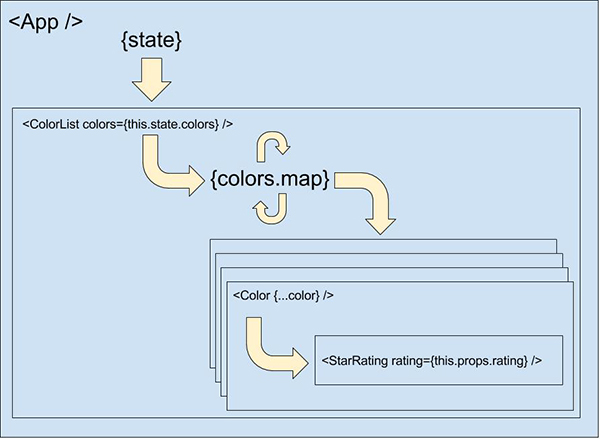
往下传数据
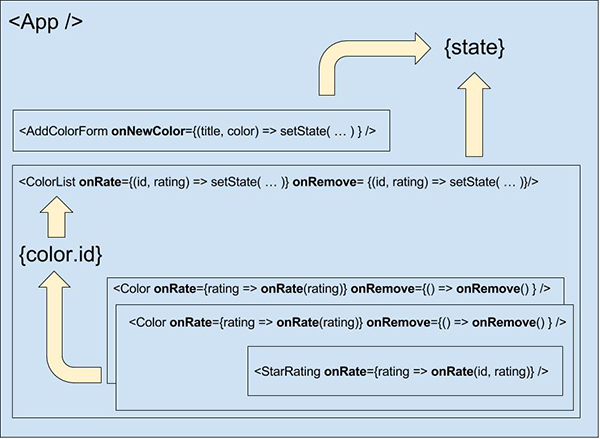
往上传数据
CSS Modules
理解 CSS Modules
一张图理解 CSS Modules 的工作原理:
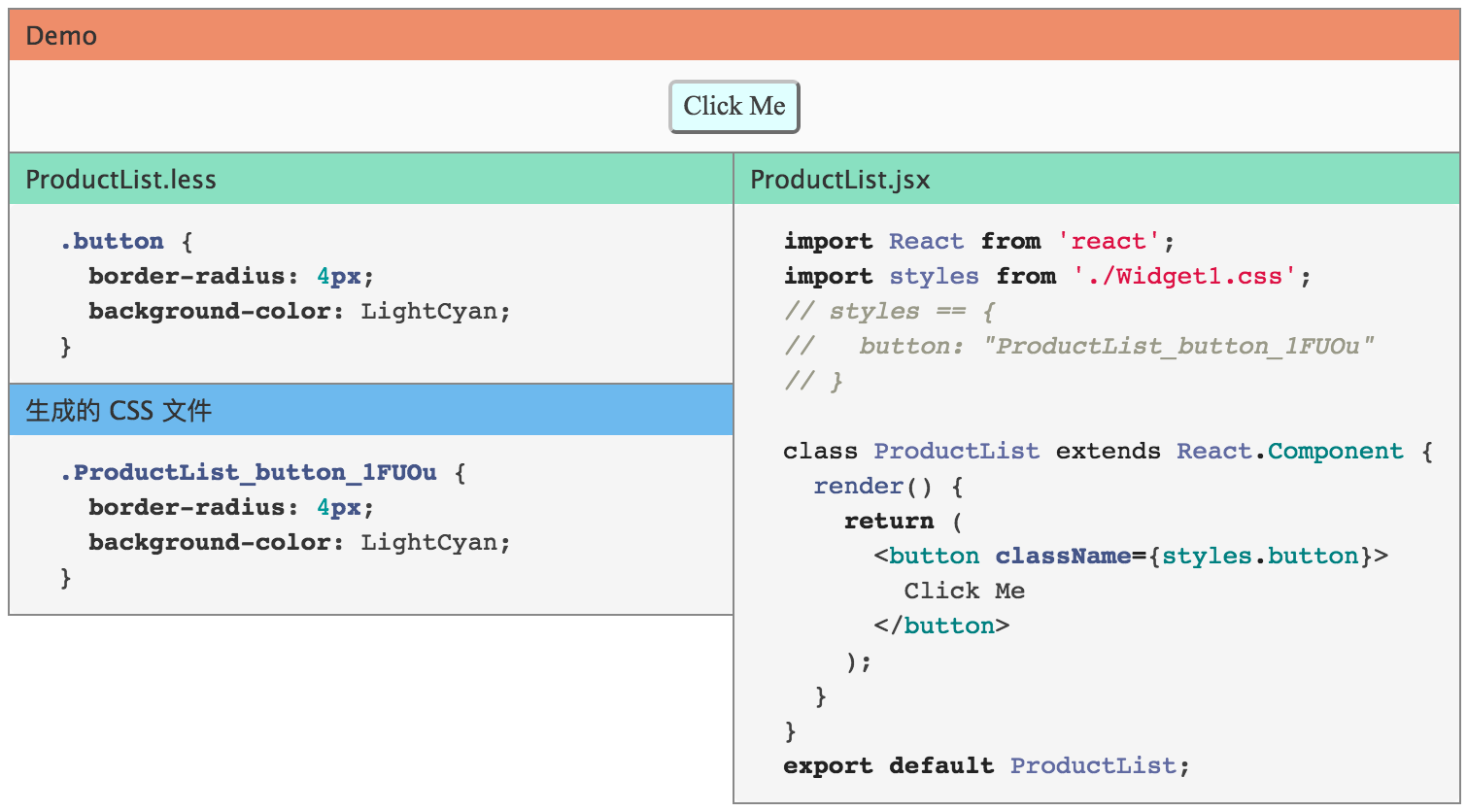
button class 在构建之后会被重命名为 ProductList_button_1FU0u 。button 是 local name,而 ProductList_button_1FU0u 是 global name 。你可以用简短的描述性名字,而不需要关心命名冲突问题。
然后你要做的全部事情就是在 css/less 文件里写 .button {...},并在组件里通过 styles.button 来引用他。
定义全局 CSS
CSS Modules 默认是局部作用域的,想要声明一个全局规则,可用 :global 语法。
比如:
.title {color: red;}:global(.title) {color: green;}
然后在引用的时候:
<App className={styles.title} /> // red<App className="title" /> // green
classnames Package
在一些复杂的场景中,一个元素可能对应多个 className,而每个 className 又基于一些条件来决定是否出现。这时,classnames 这个库就非常有用。
import classnames from 'classnames';const App = (props) => {const cls = classnames({btn: true,btnLarge: props.type === 'submit',btnSmall: props.type === 'edit',});return <div className={ cls } />;}
这样,传入不同的 type 给 App 组件,就会返回不同的 className 组合:
<App type="submit" /> // btn btnLarge<App type="edit" /> // btn btnSmall
Reducer
reducer 是一个函数,接受 state 和 action,返回老的或新的 state 。即:(state, action) => state
增删改
以 todos 为例。
app.model({namespace: 'todos',state: [],reducers: {add(state, { payload: todo }) {return state.concat(todo);},remove(state, { payload: id }) {return state.filter(todo => todo.id !== id);},update(state, { payload: updatedTodo }) {return state.map(todo => {if (todo.id === updatedTodo.id) {return { ...todo, ...updatedTodo };} else {return todo;}});},},};
嵌套数据的增删改
建议最多一层嵌套,以保持 state 的扁平化,深层嵌套会让 reducer 很难写和难以维护。
app.model({namespace: 'app',state: {todos: [],loading: false,},reducers: {add(state, { payload: todo }) {const todos = state.todos.concat(todo);return { ...state, todos };},},});
下面是深层嵌套的例子,应尽量避免。
app.model({namespace: 'app',state: {a: {b: {todos: [],loading: false,},},},reducers: {add(state, { payload: todo }) {const todos = state.a.b.todos.concat(todo);const b = { ...state.a.b, todos };const a = { ...state.a, b };return { ...state, a };},},});
Effect
示例:
app.model({namespace: 'todos',effects: {*addRemote({ payload: todo }, { put, call }) {yield call(addTodo, todo);yield put({ type: 'add', payload: todo });},},});
Effects
put
用于触发 action 。
yield put({ type: 'todos/add', payload: 'Learn Dva' });
call
用于调用异步逻辑,支持 promise 。
const result = yield call(fetch, '/todos');
select
用于从 state 里获取数据。
const todos = yield select(state => state.todos);
错误处理
全局错误处理
dva 里,effects 和 subscriptions 的抛错全部会走 onError hook,所以可以在 onError 里统一处理错误。
const app = dva({onError(e, dispatch) {console.log(e.message);},});
然后 effects 里的抛错和 reject 的 promise 就都会被捕获到了。
本地错误处理
如果需要对某些 effects 的错误进行特殊处理,需要在 effect 内部加 try catch 。
app.model({effects: {*addRemote() {try {// Your Code Here} catch(e) {console.log(e.message);}},},});
异步请求
异步请求基于 whatwg-fetch,API 详见:https://github.com/github/fetch
GET 和 POST
import request from '../util/request';// GETrequest('/api/todos');// POSTrequest('/api/todos', {method: 'POST',body: JSON.stringify({ a: 1 }),});
统一错误处理
假如约定后台返回以下格式时,做统一的错误处理。
{status: 'error',message: '',}
编辑 utils/request.js,加入以下中间件:
function parseErrorMessage({ data }) {const { status, message } = data;if (status === 'error') {throw new Error(message);}return { data };}
然后,这类错误就会走到 onError hook 里。
Subscription
subscriptions 是订阅,用于订阅一个数据源,然后根据需要 dispatch 相应的 action。数据源可以是当前的时间、服务器的 websocket 连接、keyboard 输入、geolocation 变化、history 路由变化等等。格式为 ({ dispatch, history }) => unsubscribe 。
异步数据初始化
比如:当用户进入 /users 页面时,触发 action users/fetch 加载用户数据。
app.model({subscriptions: {setup({ dispatch, history }) {history.listen(({ pathname }) => {if (pathname === '/users') {dispatch({type: 'users/fetch',});}});},},});
path-to-regexp Package
如果 url 规则比较复杂,比如 /users/:userId/search,那么匹配和 userId 的获取都会比较麻烦。这时推荐用 path-to-regexp 简化这部分逻辑。
import pathToRegexp from 'path-to-regexp';// in subscriptionconst match = pathToRegexp('/users/:userId/search').exec(pathname);if (match) {const userId = match[1];// dispatch action with userId}
Router
Route Components
Route Components 是指 ./src/routes/ 目录下的文件,他们是 ./src/router.js 里匹配的 Component。
通过 connect 绑定数据
比如:
import { connect } from 'dva';function App() {}function mapStateToProps(state, ownProps) {return {users: state.users,};}export default connect(mapStateToProps)(App);
然后在 App 里就有了 dispatch 和 users 两个属性。
Injected Props (e.g. location)
Route Component 会有额外的 props 用以获取路由信息。
- location
- params
- children
更多详见:react-router
基于 action 进行页面跳转
import { routerRedux } from 'dva/router';// Inside Effectsyield put(routerRedux.push('/logout'));// Outside Effectsdispatch(routerRedux.push('/logout'));// With queryrouterRedux.push({pathname: '/logout',query: {page: 2,},});
除 push(location) 外还有更多方法,详见 react-router-redux
dva 配置
Redux Middleware
比如要添加 redux-logger 中间件:
import createLogger from 'redux-logger';const app = dva({onAction: createLogger(),});
注:onAction 支持数组,可同时传入多个中间件。
切换 history 为 browserHistory
先安装 history 依赖,
$ npm install --save history
然后修改入口文件,
import createHistory from 'history/createBrowserHistory';const app = dva({history: createHistory(),});
工具
通过 dva-cli 创建项目
先安装 dva-cli 。
$ npm install dva-cli -g
然后创建项目。
$ dva new myapp
最后,进入目录并启动。
$ cd myapp$ npm start
通过 umi 使用 dva
先安装 dva-cli@next 。
$ npm install dva-cli@next -g
然后创建项目。
$ dva new myapp
最后,进入目录并启动。
$ cd myapp$ npm start
