@dxbdly
2021-08-29T05:38:38.000000Z
字数 9076
阅读 247
G2020 19寒假集训Day6
信息学——19寒假集训
今天是G2020寒假集训Day6,今天的主题是毒瘤的 计算几何
数学不是很好,有写得不对或写得不是很清楚的请见谅。
:有些东西的确写得不准确啊……凑合着看吧,咕了。
一. 向量
定义:
向量的定义:
向量表示的是一个有大小和方向的量,在平面坐标系下它与点一样也用两个数来表示。这两个数的实际含义是将这个向量的起点移至原点后终点的坐标。
我们用来表示一个向量。其实我们可以将向量看成点的另一种形式。
向量的基本运算
关于向量的四则运算,还是比较简单的
直接放代码啦~~~
//The code is from dxbdlystruct Vec{double x,y;Vec(double X=0,double Y=0):x(X),y(Y){}Vec operator+(const Vec &k)const {return Vec(x+k.x,y+k.y);}Vec operator-(const Vec &k)const {return Vec(x-k.x,y-k.y);}Vec operator*(const int &k)const {return Vec(x*k,y*k);}Vec operator/(const int &k)const {return Vec(x/k,y/k);}}
应该能看懂吧,下面看几个比较特殊的。
向量的点积
设 向量,向量
则两向量的点积:
点积的几何意义:
若两向量与的夹角为,他们的点积为:
使用点积判断两向量夹角情况:
(PS:点积满足交换律)
代码:
//The code is from dxbdlyinline double dj(Vec a,Vec b)//点积{return a.x*b.x+a.y*b.y;}
向量的叉积
叉积与点积比较相似。
设 向量,向量
两向量的叉积:
叉积的几何意义:
所以我们容易求出两向量构成的三角形面积。
使用叉积判断两向量位置关系:
补充:判断线与向量的位置关系只需在直线上任取一向量看两向量之间的位置关系即可。
(PS:注意叉积不满足交换律!!!)
代码:
//The code is from dxbdlyinline double cj(Vec a,Vec b){return a.x*b.y-a.y*b.x;}
向量的极角
对于一个向量我们可以通过函数(内有)得到他的极角。
向量的旋转
设 向量旋转了
旋转公式:
矩阵形式:
二.凸包
1.凸包定义与性质:
定义:
凸包:平面凸包是指覆盖平面上n个点的最小的凸多边形。上凸壳:凸包的上半部分下凸壳:凸包的下半部分。
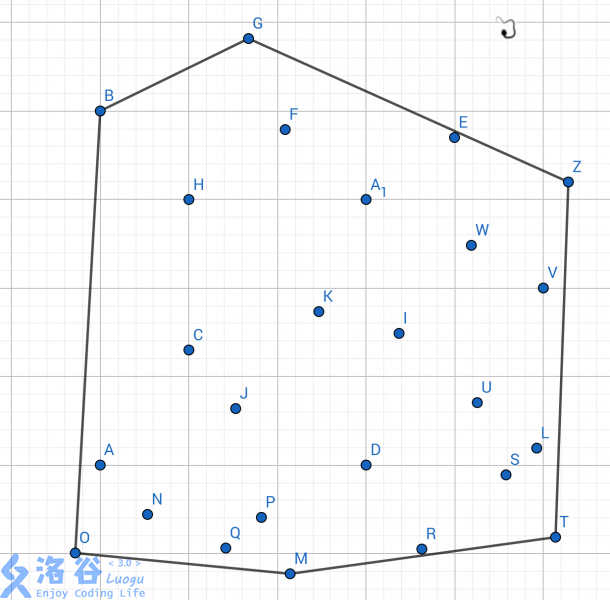
性质:
凸壳的凸性:对于一个凸壳,所有线段的斜率满足单调性。
2.Graham算法
算法本质:
Graham扫描算法维护一个凸壳通过不断在凸壳中加入新的点和去除影响凸性的点最后形成凸包
算法流程:
1. 排序2. 扫描
我们先将所有向量按极角序排序。
然后维护一个存点的栈要求栈内斜率单调(满足凸性)。
我们每次将一个点加入栈中,判断是否会与前面冲突。
如果有冲突将前面的点删除即可,最后留下的点便是凸包。
判断的方法么:
//The code is from dxbdlyinline bool check(Vec a1,Vec a2,Vec b1,Vec b2){return (a2-a1)*(b2-b1)<0.0;}
总代码:(不是我写的……)
//The code is not from dxbdly#include<iostream>#include<cstdio>#include<cmath>#include<algorithm>using namespace std;int n,top;double ans;struct data{double x,y;}p[10001],s[10001];double dis(data a,data b){return sqrt((a.x-b.x)*(a.x-b.x)+(a.y-b.y)*(a.y-b.y));}double mul(data p1,data p2,data p0){return (p1.x-p0.x)*(p2.y-p0.y)-(p2.x-p0.x)*(p1.y-p0.y);}inline bool cmp(data a,data b){if(mul(a,b,p[0])==0)return dis(a,p[0])<dis(b,p[0]);return mul(a,b,p[0])>0;}void graham(){top=2;data t;int k=0;for(int i=1;i<n;i++)if((p[k].y>p[i].y)||(p[k].y==p[i].y&&p[k].x>p[i].x))k=i;t=p[0];p[0]=p[k];p[k]=t;sort(p+1,p+n,cmp);s[0]=p[0],s[1]=p[1],s[2]=p[2];for(int i=3;i<n;i++){while(top&&mul(p[i],s[top],s[top-1])>=0)top--;s[++top]=p[i];}s[++top]=p[0];for(int i=0;i<top;i++)ans+=dis(s[i],s[i+1]);}int main(){//freopen("fc.in","r",stdin);//freopen("fc.out","w",stdout);scanf("%d",&n);for(int i=0;i<n;i++)scanf("%lf%lf",&p[i].x,&p[i].y);graham();printf("%.2lf",ans);return 0;}
3.Andrew算法
算法思路:
1.按x坐标为第一优先级,按y坐标为第二优先级排序。2.分别维护上下凸壳,将两个凸壳合并形成凸包。
直接放代码:
//The code is from dxbdly#include<bits/stdc++.h>#define int long long#define INF 1e12using namespace std;inline int read(){int x=0;bool f=0;char c=getchar();while (!isdigit(c))f|=(c=='-'),c=getchar();while (isdigit(c))x=(x<<3)+(x<<1)+(c^48),c=getchar();return f?-x:x;}int n,top;struct Vec{double x,y;}point[100005];Vec st[100005];double ans;inline bool operator <(Vec a,Vec b){return a.x!=b.x?a.x<b.x:a.y<b.y;}inline Vec operator -(Vec a,Vec b){return (Vec){b.x-a.x,b.y-a.y};}inline double operator *(Vec a,Vec b){return a.x*b.y-a.y*b.x;}inline bool check(Vec a1,Vec a2,Vec b1,Vec b2){return (a1-a2)*(b1-b2)<0.0;}inline double get_dis(Vec a,Vec b){return sqrt((a.x-b.x)*(a.x-b.x)+(a.y-b.y)*(a.y-b.y));}inline void get_up(){top=0,st[++top]=point[1],st[++top]=point[2];for (register int i=3;i<=n;++i){while (top>1&&check(st[top-1],st[top],st[top],point[i]))top--;st[++top]=point[i];}for (register int i=1;i<top;++i)ans+=get_dis(st[i],st[i+1]);}inline void get_down(){top=0,st[++top]=point[n],st[++top]=point[n-1];for (register int i=n-2;i>=1;--i){while (top>1&&check(st[top-1],st[top],st[top],point[i]))top--;st[++top]=point[i];}for (register int i=1;i<top;++i)ans+=get_dis(st[i],st[i+1]);}signed main(){n=read();for (register int i=1;i<=n;++i)scanf("%lf%lf",&point[i].x,&point[i].y);sort(point+1,point+n+1);get_up(),get_down();printf("%0.2lf",ans);return 0;}
三.半平面交
1.定义:
半平面:由一条向量将平面分为两半,其中一半为半平面。半平面交:所有半平面的最大相交部分组成的多边形。
2.求法:
将线转换为两个向量表示,考虑与凸包相似的求法,将线段按向量极角序排序,维护一个栈,使其满足凸性。
就可以了吗???
答案是肯定不行的,比如下面这种情况:
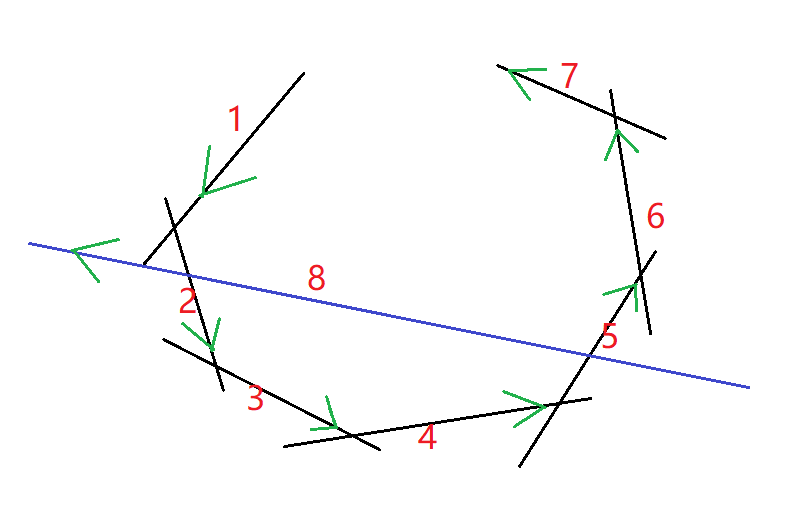
你会发现,加入新的线(蓝线)后与之前的首尾线段都有冲突!
所以我们应该用单调队列维护
将半平面交的组成线段确定之后,我们需要求出这些线段的交点。
求交点的话直接用叉积搞一下即可,不多赘述(其实我不会)
代码:
//The code is from dxbdlyinline Vec get_inter(Line a,Line b){double k1=(b.b-a.a)*(a.b-a.a),k2=(a.b-a.a)*(b.a-a.a);double cnt=k1/(k1+k2);return (Vec){b.b.x+(b.a.x-b.b.x)*cnt,b.b.y+(b.a.y-b.b.y)*cnt};}
我们还要会一件事:求任意边形面积
对于求任意n边形面积问题我们采用分割法,将其分割成n-1个三角形。对于每个三角形,我们利用叉积的几何意义求出其面积。将n-1个三角形面积相加即可。
算法流程:
1.按极角序排序。2.类Graham算法求出半平面交的边集合。3.求出所有交点坐标。3.用叉积求出面积。
其中还有一些细节,在这里列举一些
(其实计算几何就是细节多)
1.对于平行的情况我们只取最左侧的边。2.注意边界的处理。
具体的话可以根据代码看。
//The code is from dxbdly#include<bits/stdc++.h>using namespace std;inline int read(){int x=0;char c=getchar();bool f=0;while (!isdigit(c))f=f|(c=='-'),c=getchar();while (isdigit(c))x=(x<<3)+(x<<1)+(c^48),c=getchar();return f?-x:x;}int n,m,tot,len;struct Vec{double x,y;}point[1505],ans[1505];struct Line{Vec a,b;double at;}line[1505],q[1505];inline Vec operator -(Vec a,Vec b){return (Vec){a.x-b.x,a.y-b.y};}inline double operator *(Vec a,Vec b){return (a.x*b.y)-(a.y*b.x);}inline bool operator <(Line a,Line b){return a.at!=b.at?a.at<b.at:(a.b-a.a)*(b.b-a.a)>0;}inline Vec get_inter(Line a,Line b){double k1=(b.b-a.a)*(a.b-a.a),k2=(a.b-a.a)*(b.a-a.a);double cnt=k1/(k1+k2);return (Vec){b.b.x+(b.a.x-b.b.x)*cnt,b.b.y+(b.a.y-b.b.y)*cnt};}inline bool check(Line a,Line b,Line c){Vec inter=get_inter(a,b);return (c.b-c.a)*(inter-c.a)<0;}inline void work(){int head=1,tail=0,cnt=0;for (register int i=1;i<=tot;++i){if (line[i].at!=line[i-1].at)cnt++;line[cnt]=line[i];}tot=cnt;q[++tail]=line[1],q[++tail]=line[2];for (register int i=3;i<=tot;++i){while (head<tail&&check(q[tail-1],q[tail],line[i]))tail--;while (head<tail&&check(q[head+1],q[head],line[i]))head++;q[++tail]=line[i];}while (head<tail&&check(q[tail-1],q[tail],q[head]))tail--;while (head<tail&&check(q[head+1],q[head],q[tail]))head++;q[tail+1]=q[head];for (register int i=head;i<=tail;++i)ans[++len]=get_inter(q[i],q[i+1]);}inline double get_ans(){if (len<3)return 0;double sum=0;ans[++len]=ans[1];for (register int i=1;i<=len;++i)sum+=ans[i]*ans[i+1];return fabs(sum)/2;}int main(){n=read();for (register int i=1;i<=n;++i){m=read();for (register int j=1;j<=m;++j)scanf("%lf%lf",&point[j].x,&point[j].y);point[m+1]=point[1];for (register int j=1;j<=m;++j)++tot,line[tot].a=point[j],line[tot].b=point[j+1];}for (register int i=1;i<=tot;++i)line[i].at=atan2(line[i].b.y-line[i].a.y,line[i].b.x-line[i].a.x);sort(line+1,line+tot+1);work();printf("%0.3f",get_ans());return 0;}
4.旋转卡壳
这是一个有16种读音的算法
旋(xuan2)转(zhuan4)卡(qia3)壳(qiao4)
是求凸包(或多边形)最长点对距离的方法。
算法思路不难,写起来真的卡壳……
算法原理:
过凸包上两点用两条平行线将凸包“卡”住每次旋转两条平行线,使得始终有一条线贴着凸包的一条边。设这样的两个点为对踵点,则答案一定在这些对踵点中。
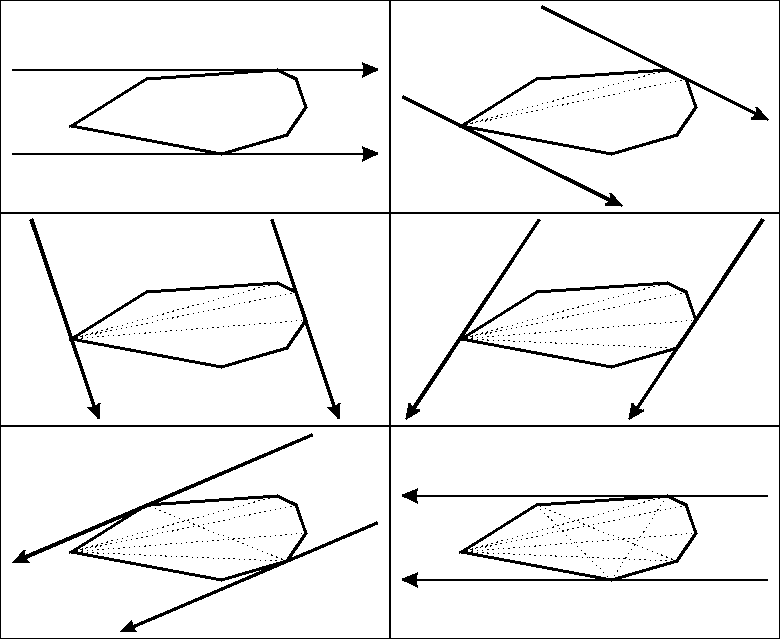
至于实现:
构造出凸包。枚举一条凸包上的边(模拟旋转)找到其对应的对踵点。
那么如何寻找对应的对踵点尤为重要。
暴力
对于每一条边枚举所有点,然后找到最优点
时间复杂度
旋转卡壳
观察发现。
我们可以发现凸包上的边与每个点的三角形面积成单峰函数
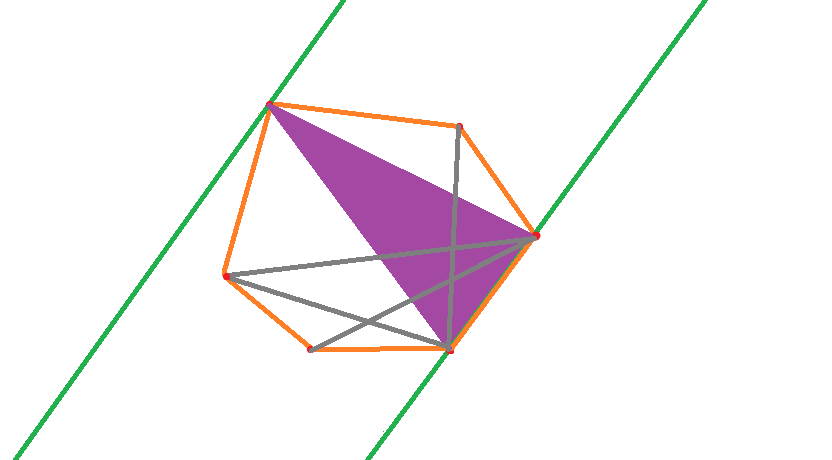
所以我们在逆时针枚举边的时候,对应的对踵点也会逆时针变化,所以我们每次从上一点开始即可。
时间复杂度
总结一下算法流程:
1.构造出凸包。2.枚举凸包上的边3.从上一次的答案开始枚举对踵点4.判断是否更新。
代码:(我没调出来……,所以不是我的)
//The code is not from dxbdly#include<bits/stdc++.h>#define eps 1e-8#define inf 1000000000#define pa pair<int,int>#define ll long longusing namespace std;int read(){int x=0,f=1;char ch=getchar();while(ch<'0'||ch>'9'){if(ch=='-')f=-1;ch=getchar();}while(ch>='0'&&ch<='9'){x=x*10+ch-'0';ch=getchar();}return x*f;}int n,top;double ans;double sqr(double x){return x*x;}struct P{double x,y;P(){}P(double _x,double _y):x(_x),y(_y){}friend P operator +(P a,P b){return P(a.x+b.x,a.y+b.y);}friend P operator -(P a,P b){return P(a.x-b.x,a.y-b.y);}friend double operator*(P a,P b){return a.x*b.y-a.y*b.x;}friend double operator/(P a,P b){return a.x*b.x+a.y*b.y;}friend bool operator==(P a,P b){return fabs(a.x-b.x)<eps&&fabs(a.y-b.y)<eps;}friend bool operator!=(P a,P b){return !(a==b);}friend bool operator<(P a,P b){if(fabs(a.y-b.y)<eps)return a.x<b.x;return a.y<b.y;}friend double dis2(P a){return sqr(a.x)+sqr(a.y);}friend void print(P a){printf("%.2lf %.2lf\n",a.x,a.y);}}p[50005],q[50005];bool cmp(P a,P b){if(fabs((b-p[1])*(a-p[1]))<eps)return dis2(a-p[1])<dis2(b-p[1]);return (a-p[1])*(b-p[1])>0;}void graham(){for(int i=1;i<=n;i++)if(p[i]<p[1])swap(p[i],p[1]);sort(p+2,p+n+1,cmp);q[++top]=p[1];q[++top]=p[2];for(int i=3;i<=n;i++){while((q[top]-q[top-1])*(p[i]-q[top-1])<eps&&top>1)top--;q[++top]=p[i];}}void RC(){q[top+1]=q[1];int now=2;for(int i=1;i<=top;i++){while((q[i+1]-q[i])*(q[now]-q[i])<(q[i+1]-q[i])*(q[now+1]-q[i])){now++;if(now==top+1)now=1;}ans=max(ans,dis2(q[now]-q[i]));}}int main(){n=read();for(int i=1;i<=n;i++)p[i].x=read(),p[i].y=read();graham();RC();printf("%d",(int)ans);return 0;}
这里面有些代码没调出来,所以不是我写的,到时候调出来了再更新吧,先凑合一下。
